Showing posts with label comparison. Show all posts

Friday, July 13, 2012

Setting the Stage for Argument


When students have to argue in their writing, they often do it adamantly, plainly, without persuasive subtlety. But an argument essay works best when the writer can draw the reader along, a friendly arm about the shoulder, persuading the reader to agree with him on minor points until suddenly they find themselves together at the writer's conclusion, and it all seems so obvious.  At least that's the hope.

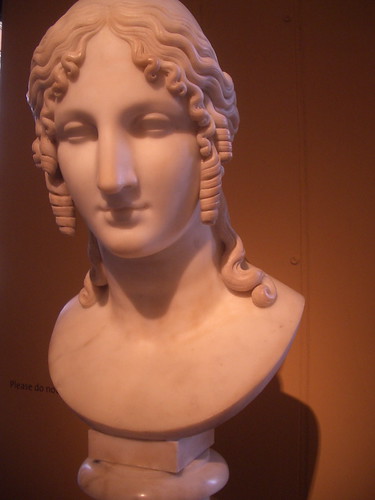
In the Progymnasma called "Confirmation/Refutation," a writer works through a set form of argument, examining the possibility, probability, credibility, and other characteristics of a proposition. The exercise gives students a chance to investigate or promulgate an urban myth, pet theory, or historical dilemma of their choice.  In the Intermediate level of my Progymnasmata Tutorial I provide my own investigation into George Washington's wooden dentures.  This summer one student decided to look into the claim of Herodotus, and later others, that Helen was never in Troy during the decade-long siege of Homer's epic.
Helen of Troy busk at the V&A, London
Michael Helvey, 10th grade, begins by setting up the history of the original story and establishing Homer as the ultimate extant source of the tale, and then showing that Herodotus is inconsistent in his quibbles and that almost no-one else agreed with him--oratory students of ancient times even took on the ridiculous challenge of TRYING to argue that Helen was not in Troy.  Then he fast-forwards us to a few centuries ago and shows how more recent thinkers have revisited the question:
In the Age of Reason, everything was most unreasonably thrown into uncertainty, with Descartes setting out to “doubt everything,” and the chronological snobbery so characteristic of Modernity automatically casting every fact from the ancient and Medieval worlds into suspicion. When men were unsure of their own existence, it is no surprise that they also doubted the veracity of Homer. John Stuart Mill, reflecting the temperament of his age, referred to the “alleged siege of Troy,” in his The Subjection of Women. Earlier, Blaise Pascal wrote that “Homer wrote a romance, for nobody supposes that Troy and Agamemnon existed any more than the apples of the Hesperides. He had no intention to write history, but only to amuse us,” (Pensées, part ix, §628). For them, Helen was not only not in Troy, but neither she nor Troy had ever existed.
A greener student might have argued something simple, like this:
In the 17th century Descartes argued that Helen was not in Troy, and John Stuart Mill questioned the whole story, calling it the "alleged siege of Troy." Others agreed.  So great minds of a few centuries ago doubted whether Helen was in Troy or even existed. But even though they doubt the story, that does not make it false.
Note how this "greener" version just puts the facts out there plainly, showing us only that people disagree, and some of those people famous smart ones. The final declaration, typical of a young writer, relies on the declaration that the existence of an opposition does not prove that opposition. That's a pretty thin argument.


But look at what Michael does in presenting this material. He uses "unreasonably thrown into uncertainty" and "chronological snobbery . . . automatically . . . casting every fact . . . into suspicion." Note the negative constructions, the twist of criticism, the accusation of narrowmindedness!  This last would be especially appealing to today's reader, even if he is himself a purveyor of chronological snobbery. 


Even more effective, note his explanation of the mindset of Descartes and Mill, "men unsure of their own existence."  Instead of dismissing these big names with reference only to their conclusions, he quotes them, letting them speak for themselves. And of course a man unsure of his own existence would be even more unsure of the existence of a woman or a city a couple of millennia before!


By presenting his opposition with interpretations of their mindset and culture, by quoting them directly to let them speak for themselves, Mr. Helvey shows true command of his material, demonstrates his deep understanding, and helping us trust him for the conclusions that are to come. 

Friday, July 6, 2012

A Brave Metaphor

David Kern, in his blog Wanderings, has a review of the movie Brave that I'm not sure I completely agree with, though I appreciate the challenge of his critique.  But I want to celebrate a great little paragraph introducing a metaphor you can understand even if you know nothing about the movie:

It’s as if the writers decided to transplant the thematic heart of the film, only they failed to properly connect all the ventricles and veins with the rest of the organs, leaving it to pump aimlessly, purposelessly. 

Well done, David!  Thanks to Lynne Spear of Sweetbriar Films for the original link.

Thursday, June 7, 2012

"The Generosity of Criticism"

Judgment leans back in its chair and, exerting the bare minimum of energy, points a thumb up or down. But critique leans forward in its chair, poised and attentive, heeding and contemplating, digesting and imagining.


--Daniel Coffeen, in "The Generosity of Criticism," * on Thought Catalog


Thanks to Rachael Webster for this piece.


*Note: noxious ad and a bit of language at the source

Thursday, March 17, 2011

Irony and Romance

A student in one section of Composition 2 at Veritas Press Scholars Academy (enrolling now, by the way!) today asked if the typical romantic comedy is ironic, and, if so, what kind of irony it represents—dramatic, verbal, or situational. (This question comes from our current assignment in irony, Chapter 13 in The Lively Art of Writing).  I’d say it’s dramatic irony in that we the audience know from the beginning that the couple will get together, or at least that A couple will get together, and we get to enjoy watching that happen through the movie or play. But it’s also situational irony in the end when they do get together, because we find out, as in You’ve Got Mail, that the bookstore rivals are actually reconciled in the most lovely sort of way.

This got me to thinking, though, and that set me to doing a bit of research, and I found a great little movie review from 2004 that addresses this subject nicely.

Romance is the genre that dramatizes our dreams of ideally effective action against the forces of evil . The white knight learns from his tutelary figure how to defeat the black knight, the ogre, the dragon, and the sorcerer in defense of the damsel and in doing so revives the entire community. He fights for the values that bind the community, earning the deepest gratitude of everyone in it who identifies with the forces of good. This gives dimension to his heroism and explains why he has been a focus of projection for boys since forever.

Irony is the genre that slaps us awake in the middle of those dreams. It apes the structure of romance but fills it in with realistic details that won't cooperate with the fantasy--e.g., Don Quixote tilting at windmills. Irony presents stories based on our lowest estimates of ourselves, saying to us, in effect, "You can fantasize all you want, but you're no hero and your plans never work out as satisfactorily as you hope." (Critics who complain that ironists look down on their characters manage to be correct and to miss the boat at the same time.)


. . . In practice, however, irony and romance aren't so cleanly antithetical. There's often a breaking point at which irony turns into romance. It can be a drag, for example, in the Robin Williams or Jim Carrey comedy that goes soft, "redeeming" the character whose outrageousness has been our main source of entertainment. . . .


Napoleon Dynamite . . . is . . . a deadpan parody of a romance. The title character is a gape-mouthed, drowsy-eyed high-school kid in small-town Idaho who longs for the kind of skills that he imagines will make him popular with girls. (Among the things he considers "skills" are having a "sweet" bike and being able to grow a mustache.) To compensate for his lack of skills he fantasizes, exaggerates, and lies, and it isn't clear that he knows the difference. (He covers notebook pages with drawings of the "liger," a hybrid of lion and tiger "bred for its magical powers," and he talks about this beast not only as if other people could have heard of it but as if it were real.) Napoleon is a loser by most external standards and we're free to laugh at him because he's not even loveable. He has the petulance of an adolescent who's always ready to snap at people because they aren't able to guess what he's thinking. They actually have to ask him questions to find out. Idiots!

Jon Heder gives a classic slapstick performance, something along the lines of the silent great Harry Langdon, that sleepy-headed weirdo baby, after a hormonal growth spurt. You have to see Heder move; he runs, dances, and even swallows in gangly character. And he never appeals directly to the audience but understands that irony is a form of identification with character, with Napoleon's very awkwardness and preposterousness. . . .

Tina Majorino is nearly Heder's equal as the shy but enterprising girl who loves him. A gravely self-serious photo-i.d. photographer and lanyard artisan , she's got her own absurd dimness, an independent source of comedy.

( From “Irony and Romance: The Sliding Scale,” by Alan Dale, October 4, 2004 )

Monday, June 28, 2010

Gorgeous Website of Art in Willa Cather's Works


If you've ever read Death Comes for the Archbishop, you can just see how the opening scene comes from the painting above. Very cool.

Now I'm excited about this website that collects a number of works related to Cather's books! Thanks so much to my friend Lyn in NC for posting this.

Monday, March 1, 2010

Pagan Gods and Leviathan

Thanks to Joe Carter of First Things, an intriguing book review about the nature of Jewish and of Christian thought as expressed in literature:

"Why There is No Jewish Narnia"

The part about Leviathan is amazing . . .

Has anyone read Lev Grossman's The Magicians?

Friday, January 8, 2010

A Sentence Exercise--Modifying Phrases

My local high school students recently had an assignment adapted from Brooks Landon's Building Great Sentences: Exploring the Writer's Craft. Learn more from my post here.

In this particular assignment they were to use modifying phrases to create a sentence with this structure:

They sat down at the table, he _________,
his _________, his ________,
she _______,
her ________, her ________,
the table _________,
its __________, its __________,
the overall scene suggesting ____________.

The real danger of this sentence form, which some have discovered, is falling into the temptation to make independent clauses out of the modifying phrases, like this:

They sat down at the table, he pulled out the chair for her so she could sit down, his eyes marvelling at her black silk dress, his cheeks reddening with cmbarrassment realizing that he had missed a button, she buttoned the button for him, her cheeks were reddening with a warmth of love, her eyes glancing him over, the table set before them, its layout perfect, its craftwork without flaw, the overall scene suggests that they are in love.

I really like the little story created in this scene, but those verbs need to be changed to "pulling," "buttoning," "reddening" (without the "were"), and "suggesting." For the remaining samples, I've made small grammatical corrections.

This student was hungry, I think:

They sat down at the table, he cutting the turkey, his face in solemn concentration, his hands working back and forth thoughtfully, she patiently waiting for him to be done, her plate covered with stuffing, her napkin in her lap, the table weighed down with food, its highly polished surface covered with an elaborate tablecloth, its size a little big for the two people, the overall scene suggesting Thanksgiving dinner.


Here's a very different atmosphere with the same setup:

They sat down at the table, he with his feet crossed on its top, his hands laced behind his head, his gray eyes glaring at her, she angry as a wet cat, her arms crossed over her chest, her black eyes returning his daggers, the table seemingly unaware of the tension, this candlelit dinner fitting a romantic occasion, its rich settings contrasting the duo's shabby clothes, the overall scene suggesting an ill-matched couple's nightmare.

And this one uses the scene to suggest a whole story:

They sat down at the table, he grinning mischievously, his boyish face lit up, his blue eyes twinkling, she patiently serving him food, her tired face lined with care, her heart loving her little boy, the table almost bare, its chipped surface holding only two slices of bread and some cooked vegetables, its marred carvings indicating past wealth, the overall scene suggesting a recent war.


This exercise is an example of how creativity can work within the strictures of formulaic writing, the structure exercising students' grammatical skills and resourcefulness. These sentences might not translate well into the context of a full paragraph or story, but each provides good material from which to work in editing to a better result. It is much easier to start with something than to start with nothing.

Friday, July 3, 2009

Ghosts

Why do we persist, so many through the generations, in straining our souls’ eyes and our flesh to discern a touch from those beyond death? Why a séance, a gasp at a breeze? Why do we imagine that a long-departed loved one--one we perhaps have rosier memories of than do those who knew him better-- cares for us more than do those here with us now? We are all so beleaguered by this world, so buffeted and strained with the business of living, that we haven’t time or capacity to be so all-focused on another, or to believe that anyone else can be so focused on us, not in this world. So we remember the tenderest moments, the closest care, the happiest days with those no longer enduring the storm with us, and we imagine that they have the attention to pay us, the longing to relieve us of our troubles, if only in our confidence.

But how blind we are, such short-sighted children, to reach for those just rescued from our shipwreck, those still trembling on the deck, wrapped in scratchy blankets, clutching tin cups of steaming coffee, having their faces dried by ministering hands. The same strength that has borne them up to safety, to solidity from our wobbly, leaky boat, is even now capably reaching for us, in fact has already grasped us, even before we know it. We are insensible, blinded by tears and rain, numb to the strong arms gathering us in. We look beyond those rescuing arms with feeble longing for those no stronger than ourselves, only rescued. They know they have nothing to offer us that is needful, all their best intentions swallowed up in His greater love.

Inspired by a passage from Marilynne Robinson’s Housekeeping, quoted here: http://openlettersmonthly.com/issue/december-robinson/

Cindy Marsch
July 3, 2009

Saturday, June 27, 2009

One-Hundred-Twenty-Four-Word Sentence

I am currently working my way through the Teaching Company course "Building Great Sentences: Exploring the Writer's Craft," taught by Professor Brooks Landon of the University of Iowa. This is definitely an English major's course, and I would not inflict it on the average high schooler, but I intend to use its principles and exercises in a live writing course I'm teaching this year.

The course has 24 lectures, and I've just finished the twelfth, which has an exercise in cumulative sentence-writing. My task was to write a sentence of at least 100 words, making use of course elements like modifying phrases, parallel structure, comparison, etc. in its construction. I was also challenged to try working from just one base clause. As Professor Landon explains, the purpose of the exercises is not to create ideal sentences to be worked into prose, but to exercise our skills at different forms, so that they come to us easily and naturally when those constructions could be of use in our writing.

Here is my sentence, only slightly edited as I went along:

The swallows burst from the barn at twilight, the old structure dry and splintered, creaking in the wind, its base crowded by weeds, concrete blocks, and broken ancient rusty machines, the dimming sky one dusk purpled by clouds, streaked with that sunset's orange, another night clamped suddenly down with the sun slipping quickly into the west, still another evening held so blue, so clear, so watery green at the edges, like a still spring with tiny silent bubbling in its depths, the birds swooping out in a curve up into the sky, in a whirl of wings, in a tossing of acrobatic antics, as if they waited for their cue--the rising music, the streaking stage lights, the crowd's anticipation--to begin their daily dance.
Come join us on the deck one sunset to see what I mean!

Tuesday, May 19, 2009

Justifying Literature

This blog post, reviewing a current production of Waiting for Godot, explains a bit of why Christians should experience and study "difficult literature." I had a parent challenge the choice of Frankenstein for an upcoming course, and I should have had a better response than that it explores the nature of creation and the image of God in man. So I'll be working on that soon. :-)

Wednesday, April 29, 2009

Invention Lunch

I am trimming up a new course I have worked on this year, Apprenticeship Writing Workshop, and I came across this passage on invention I wrote and would like to share. I hope it will pique your interest and you'll enroll for the summer or the next school year!


If you have ever been faced with the horror of a blank page and an invitation to “write about anything at all,” you should appreciate the suggestions in this section. Consider an analogy from non-writing life:


You are a houseguest, perhaps staying overnight with friends-of-friends in a town where you are visiting a prospective college. The woman of the house welcomes you warmly and apologizes for needing to leave for a while, inviting you to “help yourself to lunch.” You’re really hungry, and it will be a long time until dinner. But you don’t know this lady, or where she keeps everything, or what she had in mind for you to make for lunch.


What you really need are materials—for her to set out the things you might make lunch from, so that you know the limits and the extent of what she intends. At the very least she could make a broad sweeping gesture toward the kitchen.


So let’s say she has put out cooked chicken, eggs, cheese, tomato, lettuce, onion, tortillas, bread, and a skillet, and she’s opened the herb cabinet, pots/pans cabinet, dishes cabinet, and utensils drawer to show you where those things are. That’s better.


But you also need some guidance on form—does she intend for you to COOK something or to assemble a sandwich? With the things available, you can make all kinds of things—sandwich, salad, quesadilla, omelet, wrap.


So in writing we need to create for ourselves or have provided to us in an assignment an occasion, materials, and form. This is invention—the beginnings part of it.


Wednesday, October 15, 2008

Scholastic Argument

In my course Apprenticeship Writing Workshop , Part Two, students are to create a

Scholastic Argument Modeled on Thomas Aquinas's “Just War.”

This is my attempt:


Pro-Life Voting


Question: Whether it is necessary to vote for the most pro-life candidate in an election.


Objection 1: It would seem that it is always necessary for the godly to vote for the most pro-life candidate on a ticket, because God calls us to “defend the fatherless” and our vote is the best way to do that in our government.


Objection 2: Further, whatever endangers “the least of these my brethren,” from the fertilization of an egg on, is contrary to the value of human life, so any candidate who admits of legitimacy of abortifacient drugs, embryonic stem-cell research, or abortion in the case of rape, incest, or danger to the mental or physical health of the mother is transgressing that value of life.


Objection 3: Further, any softening of the pro-life stand for an otherwise-acceptable candidate is a betrayal of the value of life. Even if the result of abstaining from voting or voting for a hopeless candidate is that the godly voter sees worse candidates elected, by his drawing away votes from a partially pro-life candidate, that godly voter must content himself with having done the right thing in a symbolic action.


Objection 4: Further, because the pro-life cause is of fundamental importance, it is incumbent upon the godly voter to choose the most pro-life candidate no matter what other positions the candidate holds.


On the contrary, the Lord calls His people to pray for government that allows them to live peaceably, that we should “do good to all men.”


I answer that the godly voter has an amazing privilege in our government, one with scope unheard of in Bible times. Each vote is fairly small in its own impact but nevertheless significant. As rulers in Scripture are called to be wise, and their trials in ruling are there evidenced and cautioned against, so voters must be wise, considering the whole of a “kingdom” or nation or even town in their voting.


Firstly, the voter must acknowledge his whole duty, not just his duty to a single aspect of governance. Even if his passion and interest lead him to focus on “life issues,” he must not ignore the rest of the scope of his “rule,” just as a godly king or governor must consider the whole of his realm.


Secondly, the voter must see that if the nation is taken over by a hostile power, or its infrastructure ruined by a disastrous economy, many lives may be lost of those already born and especially of the sick, old, or disabled.


Thirdly, no candidate for office will be ideal, either in himself or in comparison to the other candidates. One may champion “life issues” while callously downplaying the rights and needs of those already born, while another has promising plans to care for the needy, or at least not hinder our care for the needy, while not understanding well the value of unborn life. In fact, this candidate might even have a strong life ethos but apply it only at a later stage of development, say the traditional Jewish concept of “quickening.” In cases like these the godly life-loving voter must apply great wisdom and discernment, knowing that his decision will help put into office a person who will then require wisdom and discernment in exercising that office.


Fourthly, the voter’s responsibility starts before election day, beginning with identifying the best possible pro-life candidates, supporting these candidates’ campaigns, and seeking to help those candidates and office-holders better solidify their regard of life in all its ramifications. Voters can be counselors and advisors to elected officials and perhaps even live out their convictions by running for office themselves.


Reply to Objection 1: Indeed the godly are to “defend the fatherless,” but this appeal to us to use all our powers in the furtherance of preserving life speaks to the whole of our lives. With wisdom and charity we must steward our powers, recognizing that the aim of protecting life, even in the womb, goes beyond the symbolic power of a vote for a “pro-life”-labeled candidate.


Reply to Objection 2: In the aim of defending and protecting life, a lawmaker may recognize that his constituency does not embrace the full scope of a purist pro-life ethos. For the sake of building a “culture of life” in his term of office, a culture that may well one day bring life-affirming consensus even on the “hard cases,” he may find it necessary not to hold a hard line on those “hard cases” in his governance, even if he holds that line in his private convictions. In this way a candidate fully bent in the direction of life may nevertheless not set forth an intent to abolish abortifacient drugs nor to prohibit abortion in the case of rape, incest, or the endangerment of a woman’s health.


In the case of embryonic stem cell research, the lines are drawn, even by purists, only with great difficulty. Even if experimentation on new embryos is prohibited, is it also against the culture of life to make use of stem cell lines derived from embryos destroyed long ago? And if that, too, is prohibited, what of using vaccines derived decades ago from a culture derived from an unborn child? Even if a lawmaker seeks to cleanse our medical research of any reliance whatever on processes and products derived from the sacrifice of human lives, this cleansing may be a long process and require first that the lawmaker hold office, voted in by those who take the long view on life issues.


Reply to Objection 3: Those who stand alone on the moral high ground, calling others, too, to abstain from voting if no candidate fulfills their purist ethos of life, put themselves in a place of powerlessness to actually save some lives. They remove their influence from our representative government. Queen Esther used her charms to appeal to a pagan king to save her people. If she had from the beginning determined to maintain her purity as a Jew, she might have hidden or disfigured herself to become ineligible for the beauty contest, or purposely set about not to please the king. And so she would have lost her opportunity to make a difference.


So Daniel, if he had flatly refused to eat the king’s delicacies, would have been killed or turned out of the elite school. Instead he took stock of the possibilities, appealed to authority, and made his case in a winsome way.


We as voters can use our power, our influence, to find the best candidates in a field of candidates, analyzing their real potential to win office, and cast our votes in a way that will best actually further a culture of life.


Reply to Objection 4: Catholic and Protestant pro-life advocates often call themselves “co-belligerents,” recognizing that they work for the same ends in most areas of life advocacy, however much they may disagree in other areas, or even in minor points in their beliefs about the beginnings of life and the permissibility of man’s interference via contraception, for example. But sometimes it is unsettling to learn that people of a very different world view hold convictions similar to one’s own. So, for example, a racial purist like Hitler might object to abortion for the favored races and perhaps even for the others, with a view to enslaving the offspring of the lesser. Is such a person really a godlier choice than a typical “pro-choice” candidate? Or what of a simply incompetent, naïve candidate, one who holds a purist life ethos but is certain to stumble in so many other areas that he endangers the stability of our government?


Our votes in support of life may not be so cleanly and clearly discerned as we might hope. In each vote, we must consider that we have come to this opportunity for influence, with this slate of candidates, “for such a time as this.”


~1300 words

Cindy Marsch

www.writingassessment.com

10-8-08

Thanks to "Sir David M." for his comments on my effort and for his own models on his blog!


Thursday, July 17, 2008

Definition Exercise--Creative Imitation, Part Two

See July 16 post for Part One

Exercise 3.6
“Contentment” on the model of Sojourner Truth’s “A’n’t I A Woman?”

(First, I outlined the basic structure of Truth’s argument, then used that structure for my own. Because I do not have the drama to set up the argument, I begin a different way and wind up with a reference to it to tie everything together.)

On Deal or No Deal, now on NBC, or the old Let’s Make a Deal, a contestant comes to a suspense-filled decision, at a point at the top of the roller coaster: Will you keep what you have or cast it away for the unknown Other, the Possibility? What is behind that curtain, what’s in that case?

The one who chooses the modest thing he knows or thinks he knows holds interest for us only if what he passed up is worse, or if we crave seeing his disappointment at what he lost. But the contestant so resolved often crosses his arms against his chest or puts his hand on the case, illustrating with his body language the original meaning of “contentment”—“I’ll hold with this.”

Some say contentment comes with true grit, determination, hard work, and the satisfaction of a job well done. Yes, that satisfaction is a part of contentment, and does come with the knowledge that we’ve worked hard. But how often does that hard work miss the point of contentment and become focused on itself, on the sweat and the clenched fist? Better to hold loosely, easily, what comes of our work.

Others say contentment is just bearing up with What Is, being realistic, not expecting much. But how easily this becomes bitter cynicism, a drafty emptiness. The hands are missing something—half empty rather than enjoying the half full.

Still others suggest that we must be unselfish and not measure our contentment by what we have, even if it’s just a little, but we must give it all away. We must abase ourselves, claim to deserve nothing even to the point of turning away what is offered, in apathy. But what sterility there is in this kind of emptiness—no material for growth, or for sharing with a smile and enjoying something WITH another person.

If these misunderstandings of contentment were put together we’d have tension, emptiness, stagnation. But Spirit-led contentment brings freedom, fullness, and growth, which the fist, the empty hand, and the downturned hand don’t have. The case and the curtain hide secrets, surprises. But the Lord owns the cattle on a thousand hills, and every knee will bow to Him, and He sees and cares for the lily and the sparrow. Godliness with contentment brings great gain. I’ll hold with this.

© Cindy Marsch
2008

Wednesday, July 16, 2008

Definition Exercise--Creative Imitation

I have been reviewing The Writer’s Workshop by Gregory L. Roper for possible course development, and doing the exercises myself. I found a real winner yesterday, and I wanted to share what I have done with it.


Exercise 3.3
Definition of “Contentment” on the model of I Corinthians 13.


The students are asked to do a close reading of the Bible passage, taking notes on its macrostructure and microstructure, then creating a definition of another term using that structure. I found the analysis itself taught me a lot about Paul's original--how "tongues, prophecy, knowledge" are echoed later in the note that these things will fade away, and even in the description of a child's speech and thought compared with those of a mature person. I used the three elements myself to show a contrast to contentment in its counterfeits--hard work, apathy or cynicism, and asceticism.

My Best Version

Though I have true grit, determination, and a good work ethic, if I do not have contentment, in the end I am left only with sweat and a clenched fist.

And though I have a realistic view of the world, expecting little, but have no contentment, I have only bitter emptiness.

And though I humble and abase myself, requiring little, refusing to care, without contentment I cannot grow or enjoy the little I have.

Contentment puts up with a lot and still shares, does not envy others’ good, does not pride itself on being satisfied with a little;

Doesn’t push its way into good fortune or grumble or suspect its neighbors;

Does not feel glee in another’s house fire but in his neighbors’ prizes and raises and prize roses.

Contentment satisfies. Realism, asceticism, even hard work leave emptiness.

For these are slender, futile, pale.

But when the rich fullness comes, these ghosts will flee.

When I started my adulthood, I worked hard, cultivated realism, disciplined myself to do with less. But in the Spirit I see there is so much to enjoy!

For now we feel privation, a tinge of envy, the frustration of a fallen world, but then we will know feasting, fullness, all in all.

And even now in our hearts grow faith, hope, love—and contentment is to rejoice in all of these.

© Cindy Marsch
2008


I highly recommend this kind of exercise! I came up with some other terms that could be profitably defined on this model: mercy, courage, kindness, honor, care, loyalty, faithfulness, patriotism, selflessness (see Lewis on "unselfishness"), justice, cleanliness, purity, honesty, gentleness, self control, piety, trustworthiness, neatness, punctuality, fitness, health, moderation, passion, creativity, consistency, calm, energy, quietness, spunk, liveliness, wit, humor, cleverness, and intelligence. I thought of them in this order, and I'm sure I could go on!

If you're interested in a course of such exercises, stay tuned to my web site!

Wednesday, March 26, 2008

Effective Comparison--Homer and Xenophon

This excerpt of the last portion of student Wade C.'s essay comparing Xenophon's Persian Expedition and Homer's Odyssey shows nicely how comparative sentences and good transitions can unify and strengthen the common comparison essay. This form can often be very flat and uninteresting, but this one is lively and rich. Notice how the second paragraph here begins with a sentence that clearly shows us "the other hand" of the comparison. The concluding paragraph is more standard, showing us the topic ideas that were covered in the essay, but the zinger at the end echoes the title, "Men Without a Leader and a Leader Without Men."


Finally, the obstacles the armies face were vastly different. Odysseus’s army faced an array of foes with supernatural powers that must be overcome by cunning and trickery- strengths of Odysseus. An example of this is their adventure on Circe’s island. The men were only too happy to feast with the beautiful enchantress, and rushed head on into Circe’s trap, despite Odysseus’s warnings. When the men were turned into pigs, Odysseus came to rescue them, and defeated Circe by his cunning.

The obstacles that Xenophon’s forces faced were more realistic, yet often equally insurmountable by force. The large Greek army could defeat any cities in its path, but even these victories would cost them men. If they attempted to fight all in their path, their force would gradually dwindle to nothing. Whenever possible, they had to negotiate treaties with the people they encountered. If this failed, military action was the only course. At these times, the men worked together to execute a plan to defeat the enemy with minimal loss.

Comparing the two expeditions helps show more clearly why they ended so differently. Motivation, teamwork, and the nature of the obstacles they faced determined why Xenophon and his men returned home safely, yet without their leaders, while Odysseus returned home a leader without men.

Sunday, March 9, 2008

Clear Thinking From the Start

One of the best ways to write a good essay is to get a good start. One student's topic proposal shows some sloppiness that is going to make things tough for her from the beginning. In Great Books Writing Workshop: Christendom students are writing basic thesis papers and using illustrations from John Bunyan's Pilgrim's Progress to support the thesis. I invited students to submit several topic ideas with brief notes on a character or scene from the book that would work with that topic. She submitted this:

  • Here's my topic options and characters. I'm thinking about going Persevering or judging a person's character for my topic.

Yes, it should read, "Here are my topic options and characters. I'm thinking about 'persevering' or 'judging a person's character.'" There are at least four errors in just these nineteen words, but the basic meaning is pretty clear. If this student had written these two sentences more correctly, she would have established a more academic "stance" from the beginning, taking herself more seriously and helping me to take her intentions more seriously, even though this is an informal submission, just to get my feedback on her ideas. She goes on to the first topic idea:


  • Topic: Being a Christian in only word, but the roots of your beliefs are only skin deep.

Again, the meaning is fairly clear, but it is just plain sloppy to say "in only word" rather than "only in word," and a simple "but not in deed" would help a lot. And why the "but" here? The second part of the "sentence" is an expansion on the first idea, not a contrast to it. Notice the mixed metaphor of roots and "skin deep." Either of these would work, but we have a collection of half-metaphors. As this student tries to move on to DO something with this topic, she's going to have "words," "roots," and "skin deep" kind of floating around in her mind, failing to coalesce into a clear concept. Now if she is thinking of all the possibilities of metaphor, she could expand a bit on each one to have it before her for future consideration.

A Christian in word but not in deed is a hypocrite, right? But someone who has shallow beliefs may be sincere in those and thus just ignorant or weak, but with potential for growth. The hypocrite needs repentance. So which is this student thinking of? She goes on with the brief note I'd asked for:

  • Illustrative Character: Talkative, a character, who is all talk and no action, a Christian in words, not deeds. He knows how to weave a religious tale but cannot follow his own advice, a lot like the Pardoner from Chaucer's Canterbury Tales except for Talkative's intentions are good.

NOW we have the "deeds" to contrast with the words, and that's good. And the parallel phrase that says the same thing is helpful, so the student is getting somewhere now. Note that she explains HOW he has words but no deeds, talk but no action--he can tell a tale but not follow his own advice. There is a little disjoint here--should we assume the tale includes advice, or are they separate?

I am pleased to see the note about the Pardoner--this shows that the student is expanding her thinking to an earlier reading in the course, and that's what we teachers all long for, isn't it? :-) The brief note here is okay, a jog to her memory for the future.

And then there is an assertion for possible challenge--ARE Talkative's intentions good? Were the Pardoner's intentions completely bad? This topic has great potential for comparison of these two, whether they wind up being much alike or very different.

Even a small blurb in a topic exploration needs precision and clarity.

Monday, March 3, 2008

Christina Rossetti Comparison

In an essay on Christina Rossetti's two poems "A Birthday" and "A Better Resurrection," my student Abigail M. (not to be confused with my daughter Abigail M. who also writes nicely) does some beautiful things. This is her penultimate paragraph, and a great example of a comparison that makes a point. The last phrase really hangs there in our contemplation...


Together these poems present a picture. The heart of a woman leaps up at the return of her lover. But the crowning experience is that of a soul rising from its ashes – a soul saved. However, while Rossetti places her faith in Jesus, in his death and resurrection, she also looks forward to his return. "A Birthday" could easily follow "A Better Resurrection" and become analogous to the return of Christ to his bride, the church – an event calling for all the splendor and celebration Rossetti can imagine. Or perhaps "A Birthday" does come before "A Better Resurrection". Perhaps Rossetti expresses, through this ordering, her ultimate faith and security in Jesus. Men may fail. Many a lover does not return. But Jesus died, rose, lives, and will return. He has, in life, already suffered, and as Rossetti suffers in life, as she feels loneliness, numbness, sickness of soul, she looks to the man who suffered in her place, and she choose[s] to suffer for him, clinging to his name.