Showing posts with label homeschooling. Show all posts

Monday, June 22, 2015

What's Next for Writing Assessment Services


Here's a little teaser for my clients and other friends:

In July I will begin setting up some exciting new offerings for Writing Assessment Services for 2015-16 - live classrooms for one-time and ongoing writing workshops, and a version of "office hours" and one-on-one tutoring.

I want to make the most of the traditional text-based evaluations I have used for decades and the online classroom/meeting structure I have used the last five years. I can't wait to share these opportunities with you!

Order now with confidence that you can change your order as you desire, or wait to order later as the offerings begin to appear - I can serve many students this year.

www.writingassessment.com

Now Entering My 20th Year Online!


Thursday, December 26, 2013

Happy New Year!

Many things have kept me from this blog for months, but we can all use something new for the New Year. Sometimes that can be a little something to freshen up our academic pursuits, and to encourage that I want to offer a bonus.

It begins with a reward--all existing clients will have 1000 words added to their current evaluation accounts, and those enrolled in courses with Writing Assessment Services can use the bonus for additional exercises within the course or for another kind of writing of their choice. For new clients it's a little incentive to go ahead and sign up for that new evaluation account or a Progymnasmata Tutorial to freshen up your school year.

I am happy to announce that I now have, courtesy of the good folks at the Association of Classical and Christian Schools, a permanent home for a great article written by Amy Kim, "Pro-gym-nas-what?!..." In this piece she details how we worked on the Progymnasmata together in my consulting relationship with The Oaks, a classical Christian school in Spokane, Washington, and how she's implemented these great writing exercises in her classroom over the years. Please find this article on my home page, at Writing Assessment Services.

Friday, October 26, 2012

The Progymnasmata and The Modern Essay

Early this morning I wrote a response to a client wondering how to "sell" the Progymnasmata to parents interested in preparing their students to write "modern essays."  Below, in its email-y roughness but edited a bit for this post, is my response to her:

I have been very pleased that the Progymnasmata actually turn into some modern essay types with a bit of stylistic spin (and sometimes without it). For example, Frank D'Angelo (Composition in the Classical Tradition) uses a modern magazine essay, a eulogy or remembrance of Ralph Ellison, as an example of encomium/praise, and it's amazing to me how much the magazine piece follows the classic form.
Ultimately a student is supposed to use the smaller tools of the Progymnasmata in any way his rhetorical needs call for, and a student who can rattle off a quick proverb amplification knows just what to do when a typical quote-based SAT prompt comes around. The typical modern essay calls for perhaps definition (easy to use the amplification principles of proverb and anecdote to explore that), description (the principles if not the form of the classic exercise are appropriate here), comparison (there's a Progym for that, though more focused than the generic essay needs), thesis-support, and so forth. I think the speech-in-character is beautifully brilliant for a creative spin on a book report. Any student who can do what the Progym call for is well equipped to do high-level college essay writing, though some practice with the usual forms is not a bad idea, so students can make the leap.
I'm currently about to finish the book Racing Odysseus: A College President Becomes a Freshman Again, about a college president (not really a scholar but an administrator) who takes a sabbatical to go to St. John's College, the Great Books college in Maryland. He explains that St. Johns students go from the very old-fashioned, literally antiquated, Great Books curriculum there into all manner of jobs and graduate programs, including in the sciences, medicine, and so forth. I can see how they could, though I want to talk to my husband, a physics professor, about that. :-) In my experience the students who have done well in the Progym are over-prepared for whatever college writing will bring to them. Dorothy Sayers says in "The Lost Tools of Learning" that deep study of any one discipline can teach one how to study any other, and thus she champions Latin as the gateway to all learning. Memoria Press is grabbing hold of that principle in its curriculum, though I'm a little wary of it for those interested in the sciences and math.
For the modern essay as most of us know it, I can recommend Lucile Vaughan Payne's classic The Lively Art of Writing (Mentor Series)
I was dubious when Veritas Press Scholars Academy wanted me to use it for the Composition II course I developed (with a co-teacher and friend), but I'm in my third year of working with it and think Payne has some great principles for students needing to learn how to build a thesis-support essay. The instruction in this cheap little book (or portions of it) could be of great use as a supplement to the Progymnasmata.
How's that for a pep talk?

Monday, August 20, 2012

Need a Great Composition Course in Your Homeschool Curriculum This Year?

If you want a solid essay-writing course this year, appropriate for students about grade 8 and up, using Lucile Vaughan Payne's enduring The Lively Art of Writing as well as the venerable Elements of Style by Strunk and White . . .


  • Incorporating daily in-class writing exercises, lively interaction with other students, four substantial essays during the year with two substantial revision essays and impromptu writing in final exams . . .
  • And taught by me, the popular Chris Finnegan, or the sharp and youthful Jessica Sperry . . .
  • Meeting on Mondays and Wednesdays or Tuesdays and Thursdays, two ninety-minute classes per week . . .
  • Beginning just after Labor Day, with Orientation next week . . .
  • For $595, or approximately $6 per contact hour over the year . . .


Then join us at Veritas Press Scholars Academy for the Live Online class Composition II this year.  The last I checked, every section has at least one seat available, and most have multiple seats, so bring a friend!*

Here are a few of the comments I've received over the last two years:


"Your class has provided B. with a solid foundation for writing. I have witnessed the maturity in her writing skills. Your uncompromising standards required B. to push herself to perform at a higher level. The lessons learned were not merely writing skills but life skills. During the year I listened to bits and pieces of class, read your emails, and reviewed the comments on B's papers. In all of your communications you not only taught composition but  truly shepherded your students’ hearts!!  And as a mother I would like to say thank you for leaving your handprints on my daughter's heart!"  Mother of a student at Veritas Press Scholars Academy.

"My kids both LOVED your class. Thank you for . . . being an exceptional teacher to them. It was all I could have hoped for from a Composition class, and more." Fellow instructor at Veritas Press Scholars Academy.

 "I wanted to thank you for the semester you taught me. You gave me grace on many an occasion, and were kind enough to explain the simplest things that I somehow was unable to get. : p Thank you for everything; it was a good year!"  Student at Veritas Press Scholars Academy

*Note: This class does have a prerequisite, but if you believe you have completed the work needed to make it right for you, do apply and see what the administration says.

Wednesday, August 8, 2012

Back-to-School Freebie!

German silver binding, c.1700

Know a student who will need to write about great literature, history, theology, or philosophy this year?  Send him or her to Writing Assessment Services to download a free self-study short course to prepare for these essays. First developed in the late 1990s for students in the Great Books tutorials of Wes Callihan, Fritz Hinrichs, and Norm Lund, this versatile course gives students a thematic approach to the challenges of entering the Great Conversation, responding in writing to the things they have read and discussed in class.

Writing Prep Workshop for Great Books Papers is available through August and September.

German silver binding, c.1700


Friday, July 20, 2012

Imitation on a Small Scale

One of the best website designs I have ever seen is the very orderly Silva Rhetoricae, which organizes "the forest of rhetoric" into its "trees" and "flowers." If you go to the site and search for the term "imitation," you'll get a brief history of this amazing teaching tool in the first link. But beware--you can get lost in this enchanted forest!
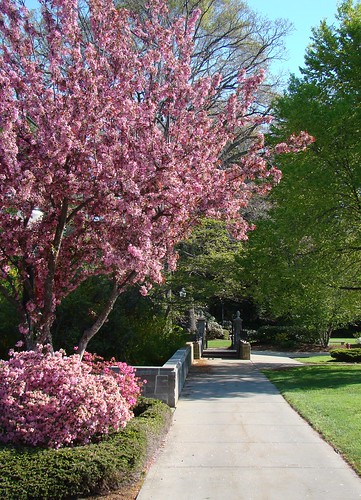
Path to Harbison Chapel

As explained in the little article linked above, imitation can be used on a grand scale or a small one. Today I want to share a brief exercise from the first quarter of the course Composition II that Chris Finnegan and I developed for Veritas Press Scholars Academy two years ago. After discussing a larger portion of an essay by Theodore Dalrymple, "Sympathy Deformed," we focused in on this pair of sentences:

To sympathize with those who are less fortunate is honorable and decent. A man able to commiserate only with himself would surely be neither admirable nor attractive.
When we want to imitate something like this, we need first to understand it, and for many a kind of shorthand can help:

Sympathize = honorable, decent
Self-sympathize = unadmirable, unattractive

In logic this comes out as S = P, Not S = Not P.  In class we discuss simple examples like "kindness is good" and "unkindness is bad" to be sure everyone gets the core of the meaning.  Then we set them loose with an imitation exercise using Dalrymple's sentence structure (and double description).  Here are a few of the student examples:

  • Peace promotes both happiness and patience. War promotes neither contentment nor fortitude. (Rob Holzknecht)  This very simple one follows the basic rules well and illustrates the principle.
  • When a person's emotions are controlled, all those around him will have peace, but when his temper consumes him, there is no calm for anyone. (H.K.)  This has more personal application and makes us nod and say, "Yes, that's very true."  It's reminiscent of the "better a corner of the housetop" Proverbs 21:9 and 25:24.
  • The ardent flames of love melt away the harsh ice of terror, leaving only comfort for those in the midst of the passionate fire. A man with no love to detect in his soul is never to feel true tranquility, but will forever remain frozen in hatred’s cold grasp. (Aubrey Muffett) Fire and ice -- obvious contrasts that help to illustrate the point, though we have to buy into the writer's equation of fire with a kind of comfortable, passionate tranquility. I expect this student was reading Dante in another class. :-)
  • To have self-control is to have a chest full of gold. A man who can only fume and yell is like the beggar who, despite his cries for money and food, receives none. (J.G.) This one has concrete images (and sounds). Note that the first sentence is quite brief and powerful. The second illustrates futility even in the length and syntax, with that final "receives none" to clinch the deal.

Want to give it a try yourself?  


Tuesday, July 17, 2012

Fees Changing August 1: Up, Down, and Steady

I am currently working on adjustments to my fees for the new school year, effective August 1. Some fees are staying the same, some are increasing, and a couple are even going down!
Arrow

If you order by August 1 you can be sure to get the best rates, and I will issue a refund for any fee that goes down after that date.

Staying the same: Resource Membership for Apprenticeship Writing Workshop, Resource Membership for Progymnasmata, and 4-assignment and 10-assignment enrollments for Great Books Writing Workshop.

Going down: Resource Membership for Great Books Writing Workshop (from $100 to $50!), One-Time Evaluation (from $60 to $50).

Going up 3% to 10%: Apprenticeship Writing Workshop, Progymnasmata Tutorials, and Evaluation Packages -- and the larger package will have more flexibility, with more submissions.

Going up 20%: The first hours of Consultation, which include free Resources or Resource Membership. I recognize the limited resources of small private schools and home schools, and it is my desire to work with clients to offer the most efficient and economical version of my services to meet their needs. Sometimes that means using existing curricula or materials developed for previous clients, or even charging only part of my time to develop materials I can use for other clients.

As an example, for an initial consultation of under $200 I have had email correspondence and an hour-long phone meeting with staff members of Samuel Fuller School, researched a curriculum they were interested in, and created for them a long-term plan for a solid writing program as the school grows, with a Resource Membership and site license in perpetuity for all my Progymnasmata materials. They desired more guidance for the year, and teacher training, and when they determined a budget for these services I came up with a plan that prioritizes their needs: full customized syllabi for two grade levels of Progymnasmata instruction for this year, evaluation of early assignments from the two classes, and phone/online coaching of the teachers on these assignments and at least two later ones as the year progresses.

May I do the same for you? Order an initial Consultation by August 1 and enjoy the lower rate throughout your project!

Monday, July 16, 2012

"Assessment That Blesses" Available Until August 3

While there's still time, listen to this talk from Andrew Kern of the CiRCE Institute: "Assessment That Blesses." And then watch for an upcoming post from me about how to apply these ideas.


  • Andrew's main message is that everybody has anxiety related to education (the student, the teacher, the parents), and that anxiety gets its power in assessment, or judgment.  On what basis will work be judged--how should we measure it?
  • To be effective, assessment must be based on the nature of the student, the nature of the subject, and the relationship between them.
  • Judgment is based on right thinking (based on accuracy, based on wisdom, based on grace), and the feedback we give students should be this measure:  what is the goal, and how far have you come along the path toward that goal?
  • We must give honor where it is due.  When a student is talented, we should praise God for that.  When the student shows virtue by working hard, we can praise the student for that.
  • When truth enters the soul, it always brings joy.


Those are the kernels of wisdom I gleaned from this talk, and I've been thinking over them for the last week or two. Stay tuned for where that thinking is going . . .
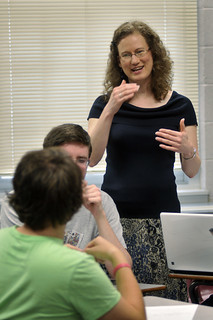
Teaching excellence

I chose this illustration photo of a really engaged teacher, Lorien Foote. It's no surprise she was given a Teaching Excellence Award by the University of Central Arkansas!

Friday, July 13, 2012

Setting the Stage for Argument


When students have to argue in their writing, they often do it adamantly, plainly, without persuasive subtlety. But an argument essay works best when the writer can draw the reader along, a friendly arm about the shoulder, persuading the reader to agree with him on minor points until suddenly they find themselves together at the writer's conclusion, and it all seems so obvious.  At least that's the hope.

In the Progymnasma called "Confirmation/Refutation," a writer works through a set form of argument, examining the possibility, probability, credibility, and other characteristics of a proposition. The exercise gives students a chance to investigate or promulgate an urban myth, pet theory, or historical dilemma of their choice.  In the Intermediate level of my Progymnasmata Tutorial I provide my own investigation into George Washington's wooden dentures.  This summer one student decided to look into the claim of Herodotus, and later others, that Helen was never in Troy during the decade-long siege of Homer's epic.
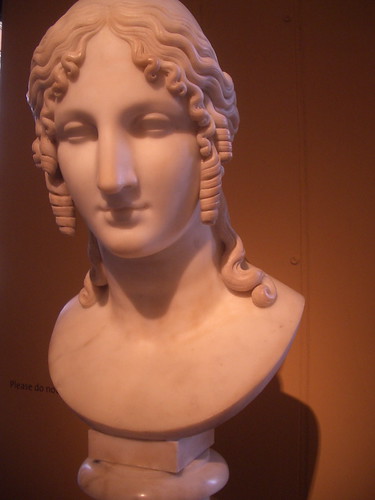
Helen of Troy busk at the V&A, London
Michael Helvey, 10th grade, begins by setting up the history of the original story and establishing Homer as the ultimate extant source of the tale, and then showing that Herodotus is inconsistent in his quibbles and that almost no-one else agreed with him--oratory students of ancient times even took on the ridiculous challenge of TRYING to argue that Helen was not in Troy.  Then he fast-forwards us to a few centuries ago and shows how more recent thinkers have revisited the question:
In the Age of Reason, everything was most unreasonably thrown into uncertainty, with Descartes setting out to “doubt everything,” and the chronological snobbery so characteristic of Modernity automatically casting every fact from the ancient and Medieval worlds into suspicion. When men were unsure of their own existence, it is no surprise that they also doubted the veracity of Homer. John Stuart Mill, reflecting the temperament of his age, referred to the “alleged siege of Troy,” in his The Subjection of Women. Earlier, Blaise Pascal wrote that “Homer wrote a romance, for nobody supposes that Troy and Agamemnon existed any more than the apples of the Hesperides. He had no intention to write history, but only to amuse us,” (Pensées, part ix, §628). For them, Helen was not only not in Troy, but neither she nor Troy had ever existed.
A greener student might have argued something simple, like this:
In the 17th century Descartes argued that Helen was not in Troy, and John Stuart Mill questioned the whole story, calling it the "alleged siege of Troy." Others agreed.  So great minds of a few centuries ago doubted whether Helen was in Troy or even existed. But even though they doubt the story, that does not make it false.
Note how this "greener" version just puts the facts out there plainly, showing us only that people disagree, and some of those people famous smart ones. The final declaration, typical of a young writer, relies on the declaration that the existence of an opposition does not prove that opposition. That's a pretty thin argument.


But look at what Michael does in presenting this material. He uses "unreasonably thrown into uncertainty" and "chronological snobbery . . . automatically . . . casting every fact . . . into suspicion." Note the negative constructions, the twist of criticism, the accusation of narrowmindedness!  This last would be especially appealing to today's reader, even if he is himself a purveyor of chronological snobbery. 


Even more effective, note his explanation of the mindset of Descartes and Mill, "men unsure of their own existence."  Instead of dismissing these big names with reference only to their conclusions, he quotes them, letting them speak for themselves. And of course a man unsure of his own existence would be even more unsure of the existence of a woman or a city a couple of millennia before!


By presenting his opposition with interpretations of their mindset and culture, by quoting them directly to let them speak for themselves, Mr. Helvey shows true command of his material, demonstrates his deep understanding, and helping us trust him for the conclusions that are to come. 

Thursday, July 5, 2012

Great Moments in Teaching

I'm so glad this teacher, Michelle Kerr, writing on the blog of Larry Cuban on June 27, 2012, shared her exhilarating hour in the classroom, and I'm glad Rod Dreher let us know about it!

"The kids carried the conversational load on that poem for ten minutes."
     --"The Miracle and the Moment"          

I love it when that happens!

She goes on to describe how what happened didn't really fit her lesson plans, that she was supervised that day and knew she'd be missing many of the stated objectives.  But something important happened there.

If you teach, I hope you have the joy of many such moments, and if you learn, I hope you are part of a miracle such as Ms. Kerr describes.  Aren't our best memories of our educations from moments like these?

Saturday, June 16, 2012

Inspiring Introduction


Read this introduction to a 900-word essay by an 11th grader and consider what works and doesn't work for you:
Coiled about the globe, a conglomeration of desktop computers, mobile devices, wireless signals, cables, and data centers form the complex, interconnected network known as “the internet”.   By seamlessly streaming information to over 2 billion of the world’s population, this mammoth machine has snaked  its way into nearly every aspect of our lives.  According to a Pew Internet & American Life Project Survey, over 80% of American adults use the internet and another 80 % of that utilizes  it daily (Trend Data [Adults]).    The primary appeal of the internet rests in the convenience of being able to access endless information at the tap of a finger.  However, this mass accessibility and abundance of information has been detrimental to society by catalyzing the propagation of plagiarism, pirating, and porn.  (Nathan Wakefield)

snake

The alliteration at the end is obvious and memorable, and it would be especially effective in a speech. It might not be quite to your taste, though. And yes, the paragraph has a few errors, especially in subject/verb agreement. But let's look at more . . .
What about that opener?  "Coiled about the globe."  You can visualize that, can't you? Does it fit what it's talking about -- the internet? I think so.  What "coils?"  A snake, of course.  Look at the next sentence, where the "mammoth machine has snaked its way" into our lives.  And of course most of us* have visceral negative reactions to snakes -- theological ones, too.  So it's pretty clear that this writer intends to say negative things about the internet, as those three P's at the end confirm.
The overall effect is a vivid, energetic image that binds the assertions to our minds in a persuasive way.  This is an effective introduction.  And a great conclusion would remind us of the snake image, and probably the P's as well. Although the author has another metaphor in his title and conclusion, he does link the conclusion to this intro with the idea that the internet is an agent of temptation. Sounds familiar, doesn't it?

*Our family members actually like snakes.

Thursday, June 7, 2012

What Revision Can Do

Revision is one of the least-appreciated parts of the writing process, but it is so important that every student should be required to revise.  However, revising without guidance is just about as frustrating as getting the favorite old assignment: "Now just take out a piece of paper and write whatever you want to!" Instead, students who need to revise need to know WHAT they need to revise.  A good evaluation can show the way.

Paper Weaving

I have just posted at Writing Assessment Services a file that will give you a peek into the process I have done with just one student, in just one course, in just this last school year.  Check out the file here, and note that I'm remodeling the site, so it's inconsistently spiffy just now.

Here's a taste of what the file includes.  First the original conclusion, and then the new one.  I think you'll see a great difference!

Original
All in all, soccer is the most entertaining sport there is.   It is suspenseful and ever changing.  There are plenty of other reasons why soccer is well liked, but without a doubt this reason is the most appropriate one. Whether it is the cultural background, or simplicity of rules, soccer is currently favored by numerous individuals.


Revised
In conclusion, it is the rarely made goals, required teamwork, and the ever-changing possession of the ball that makes soccer an entertaining and suspenseful sport for everyone.  When compared to basketball, soccer games do not have as many points flying around.  This makes soccer suspenseful, and easier to follow.  When compared to swimming, soccer is more of a team sport.  This makes soccer a good learning experience for younger player.  Compared to football, soccer is more unpredictable and ever changing.  Yes, hockey games have rarely made goal, baseball is a team sport, and basketball is unpredictable.  Nevertheless, all these aspects together make soccer the best for anyone interested in sports.   


Many thanks to Elizabeth Siddiq for allowing me to share her hard work!


In case you missed it, get the whole file here.

"The Generosity of Criticism"

Judgment leans back in its chair and, exerting the bare minimum of energy, points a thumb up or down. But critique leans forward in its chair, poised and attentive, heeding and contemplating, digesting and imagining.


--Daniel Coffeen, in "The Generosity of Criticism," * on Thought Catalog


Thanks to Rachael Webster for this piece.


*Note: noxious ad and a bit of language at the source

Wednesday, June 6, 2012

Essay Grades and Olympic Times

Over the years I have discussed with other writing teachers the reality we know -- that it is just plain difficult to get high grades on essays or creative writing. A piece of writing is an incredibly complex thing, and we as writing coaches want to urge our students to keep pushing for something better, something more successful, something more perfect.  I wrote this to an "A" student yesterday who was discouraged that she had not improved her essay grades over the year:
The fact that you have A grades on all your essays shows that you are an exemplary writer. . . . Once you're a really great writer it's difficult to make incremental improvements.  Think of runners or swimmers who try to "shave" their times once they're in the elite ranks. :-)  Yes, it's dramatically impressive when students make dramatic improvements -- and I wrote notes of congratulation to several who went from low B or high C grades early on to high B or low A grades by the end. They need to be encouraged about their strides. You just need the encouragement that you're continuing to do a great job, as you have from the start. You came into the course well equipped to do what we were looking for, and you have gone out of the course continuing to do it very well.
Bottom line: it's just about impossible to score a 100, and a 95 is rare -- because we writing teachers want to encourage students to keep pushing for excellence and beauty.  However, we should do what we can to structure the grades in a course so that students can succeed with their final grades even if their writing is not the best of what they do. In Composition 2 at Veritas Press Scholars Academy, essays count as 40% of the grade, exams as 20%, and participation and homework as 20% each.  The participation and homework grades are "faithfulness grades"* that allow even struggling writers to succeed in the class.


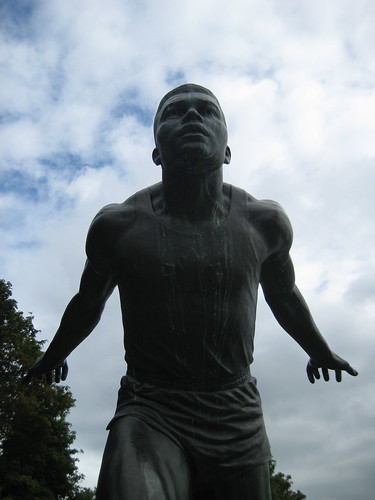
Olympic Winner Statue


All run the race, and all can finish well, but the ones who have "Olympic potential" will get more vigorous coaching to that end, not just a grin and a pat on the back.


*Thanks to husband Glenn Marsch, physics professor at Grove City College, for this concept.


Related:  Jack Lynch:  "Getting an A on an English Paper"

Monday, June 4, 2012

Welcome to Summer!

At last I'm done with the teaching year at Veritas Press Scholars Academy online, and I'm ready to spend some time developing Writing Assessment Services for you.

Wouldn't you like some help learning how to do what I do -- evaluate writing?  That's part of what I have in mind.

Wouldn't you like some actual instruction to go with my tutorials -- visuals and audio?  That's part of what I have in mind.

Wouldn't you like some freebies? That's part of what I have in mind.

Stay tuned!


Radio - 92/365

Thursday, February 23, 2012

Calvin on Writing

No, not THAT Calvin.

I do not believe this, ultimately, to be my goal for my students, but I know it's possible, and I surely read a lot of this kind of writing.  Today it's just a funny, to blow out a bit of the dust in this blog.

Calvin and Hobbes Discuss The Purpose of Writing

I'm too busy teaching writing just now to blog about it.  I shall return . . . one day . . . Lord willing. :-)

Monday, September 5, 2011

Openings in Composition 2

The shiftings of enrollments at Veritas Press Scholars Academy have resulted in my having openings in three of my course sections, at 8:00 a.m., 12:30 p.m., and 2:00 p.m. on Mondays and Wednesdays.  We do not begin our first class until this Wednesday, so I'd love to see your enrollment if you'd like to join me!  Chris Finnegan also has openings in her sections on Tuesdays and Thursdays.

Visit here to read more and to enroll:  Secondary Classes 2011-2012.

Tuesday, August 2, 2011

Partial Discount Extension

I've decided to offer a 10% discount on new orders through August 10, so you didn't miss yesterday's deadline altogether. :-)  Please email me at CindyMarsch@writingassessment.com if you have any questions.

www.writingassessment.com

Monday, August 1, 2011

Today's the Last Day!

Today is August 1, the last day to get a 20% discount on orders for the new school year!

Go here to learn more:  Writing Assessment Services

Wednesday, July 13, 2011

A Little Testimony

One of my almost eighty students at Veritas Press Scholars Academy online this past year wrote me a very sweet thank-you note at the end of the year, accompanied by a great handmade card. She gave me permission to share it here, the student's view of the value of Composition 2.  (About four of the six sections for 2011-2012 are full, but a couple of them still have seats.  My colleague Chris Finnegan made this course a great experience, and we're hard at work now making THIS year's class even better!)

Dear Mrs. Marsch,
. . . Thanks so much for teaching comp. class. I really enjoyed it! I have learned so much from the Lively Art of Writing. It didn't just say what to do, but she would tell how most students would do something then she would tell how to change it. I know I don't remember everything from the book but it still was very beneficial.
     You presented the material very effectively and I really loved your slides and polls.
     Thank you so much for taking the time to check papers and giving helpful feedback. Probably my favorite things was how we wrote the papers. We would start about two weeks before it was due. We could take it at a much slower pace and not feel rushed. So by the day it's due all we'd have to do was proof read it. I had never written a paper starting so far in advance before!
     The last paper (the one about math) I felt it was my best paper, even though it wasn't my best grade. :-p  I knew about the subject and could make my thoughts clear (that's always really hard!).
     Thanks again for teaching, helping me become a better writer, and using LAW. Really wish I could have met you at the end of the year gathering.
     Sincerely,
     Lauren Carmody
P.S. Sorry if there are grammatical errors :-p . . . it's a letter not an essay :-)